When Rob Hogan taught me how to speedgolf – and much more.
By Emil Weber

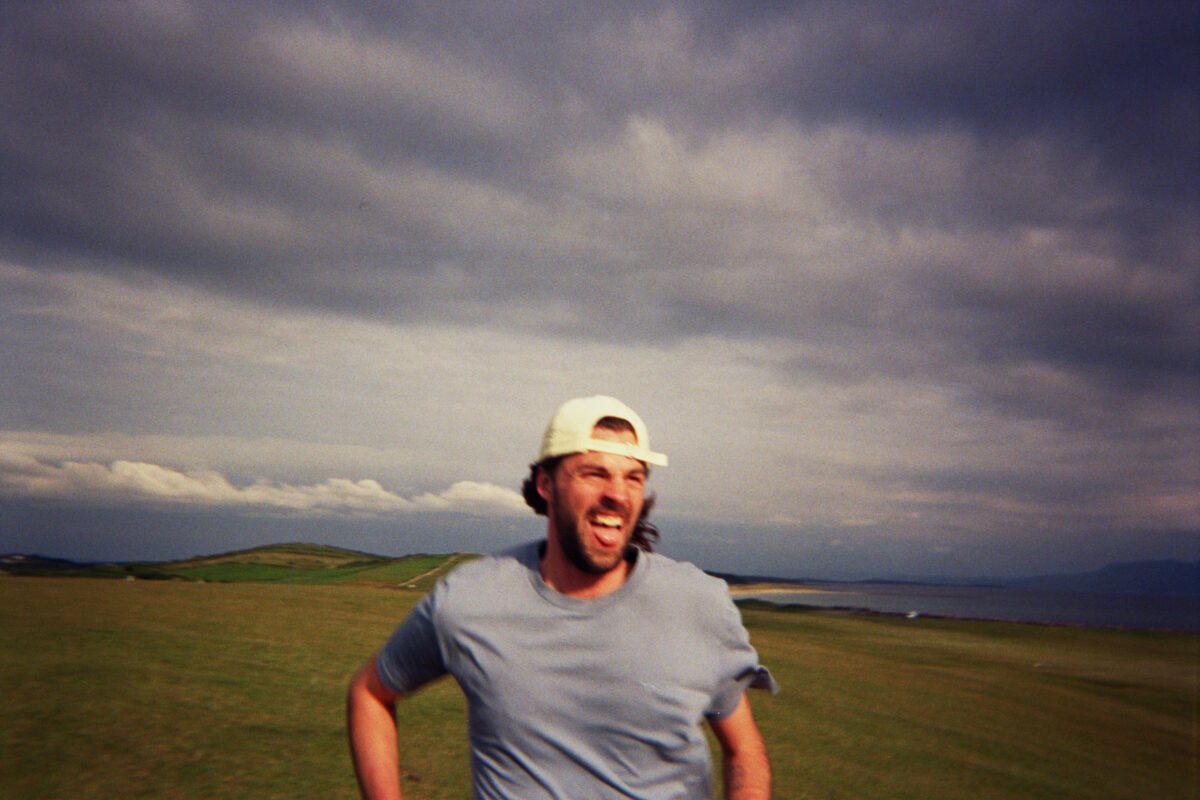
One last push. To call it running would be an overstatement but I’m moving my heavy legs uphill towards Mulranny’s 9th and final green with all that I’ve got left in the tank. My breathing has long lost the plot. All I see beyond the fenced off skyline green is me sinking to the ground in exhaustion like a triathlete on TV when this is all done. The visions are interrupted by a tall, athletic and heavily bearded man bursting into my view from the right. Rob runs past me at twice my speed, his red mane whooshing in the wind, the sheer velocity of his lean body leaving a gust of wind on my sweaty skin. “Wow! Great run, Maurice!”, he shouts back at us. From my left appears 8-year-old Maurice, half my size but clearly the fitter man. He overtakes me in the slow-motion version and there’s nothing I can do about it. We’re running up that hill.
I wouldn’t say that day changed the way I view the game but looking back, it’s made me understand things I’ve always felt about golf. Rob Hogan and I were briefly in touch a couple of years ago, when he kindly invited me to play in a speedgolf tournament in Castlebar. I didn’t go. Instead, I opted to keep travelling Ireland’s rugged west coast, falling in love with Mulranny’s charming and pure 9-hole links. Somewhere around that time, Rob – already a two-time speedgolf World Champion and pioneer of the sport – started gathering his ideas on the golf swing and stepping into a character unlike anyone the golfing world had ever known. Ironically, Rob and his family later moved to Mulranny, which was the perfect environment for his endeavours to take shape.
If you are into golf and occasionally spend time on instagram or TikTok, you will have had your scrolling interrupted by a bearded man shouting swing lessons at you, his eyes wide open staring you down. Like a mythical figure from a Michael Murphy novel, Rob seems possessed by the most obscure of golfing gods, delivering his preachings with such otherworldly conviction that they have to be true. It is entertaining at first, sure, but the more you watch him, the more you understand a pattern, the philosophy behind it. The swing as a throwing movement, the ball as the target, the mechanics as a byproduct of all that. Loosey Goosey. Golfers aren’t robots. Consistency comes through adapting to what is required. A routine finds itself in a natural process. Yes, but what does it all mean? And how does he know?
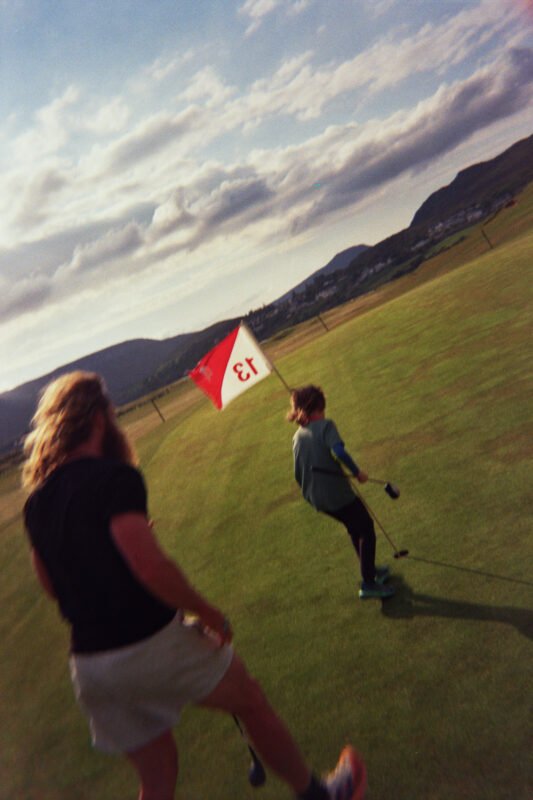
To find out, I had to travel across Ireland, back to my beloved Mulranny. The picturesque seaside village isn’t the end of the world, but that title would go to neighbouring Achill Island, so it isn’t far off. It was a sunny afternoon in May and my car was the only one in front of the container clubhouse. “I live next to the course” Rob had said but we didn’t exactly specify where to meet. How near was next to? “Come on in!” a familiar voice in an Irish accent called from afar, sparing me from having to knock on strangers’ doors.
“So, the first thing I’d say to you is to just make up your own format because all formats were invented at some point” Rob told me as we sat down at the kitchen counter. I really should have expected the warm Irish welcome by himself, his wife Ruth, a number of children and a jumpy dog. Toys, books, and other stuff were scattered around the place. The house gave off the kind of lovely, playful and slightly chaotic atmosphere you’d want to be a child in. Not to mention the 9 holes of unspoilt, affordable and rarely busy links golf at its doorstep. I had asked Rob to teach me the ways of speedgolf for this article. Also, I had suggested that we take out a disposable analog camera to capture the whole experience, because, well, I don’t really know why.
Sharing a small bottle of local beer gave us enough time to talk about his thoughts on the golf swing, Ruth’s work as an artist and different golf formats. Rob suggested an alternate shot speedgolf for that day but before I could say anything, Maurice jumped into the conversation. He was the eldest of the children in the house that day. “Can I come and play with you?” he said, looking at Rob. “Can he come and play with us?” said Rob, looking at me. “Of course,” a three-player-alternate-shot-game it was for my first ever 9 holes of speedgolf. “We’ll be back in about 25 minutes,” Rob exclaimed. ‘He hasn’t seen me run’, I thought to myself in disbelief.
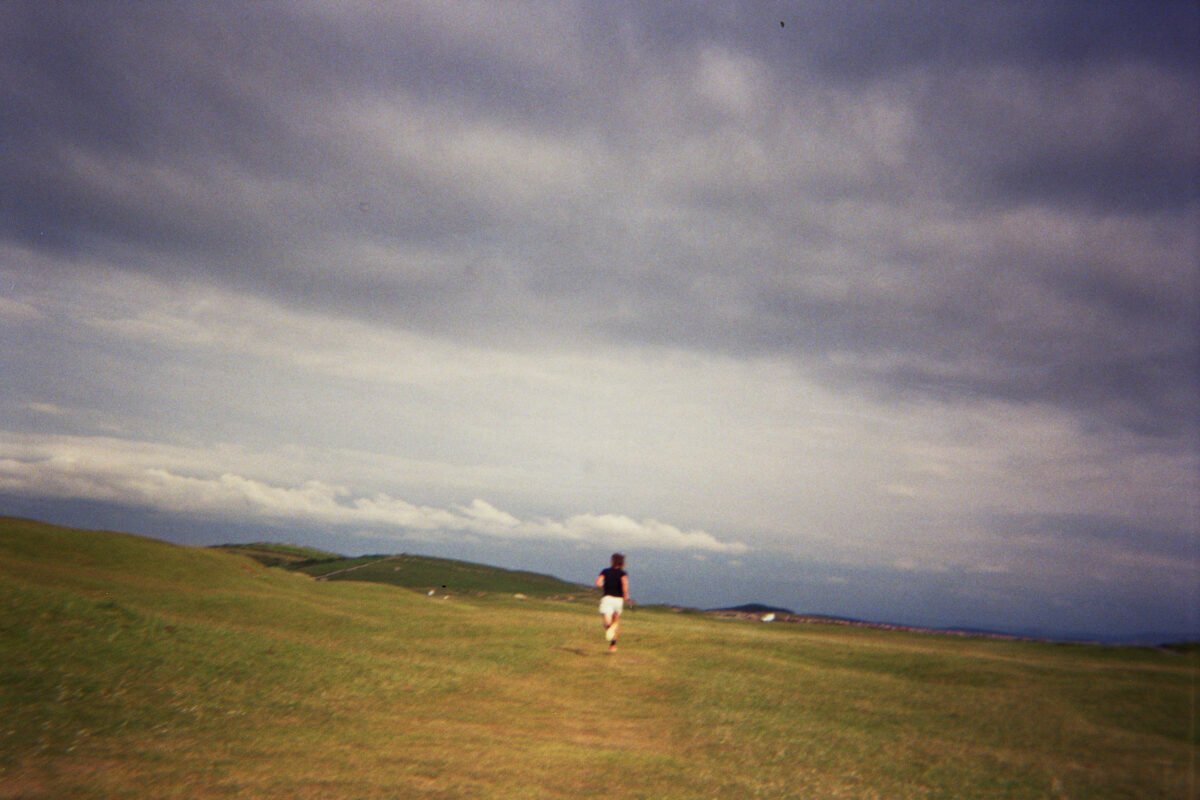
One club each in hand, we raced towards the first tee at a pace I knew I wasn’t going to keep up. The whole experience was a blur: trying to match their speed, trying not to embarrass myself as a golfer, trying to get somewhat decent footage of the whole experience. Rob kindly offered to take photos too and we kept exchanging the one disposable camera by throwing it to each other. “Who would have thought the throwing movement would be so important in golf?” I remember him saying. It was probably the only time I laughed during that round. “If you want to play speedgolf well it’s very important to have a reliable, autonomous swing.” Rob told me. “A slow PGA Tour pro will have much better chances of becoming a good speedgolfer than a fast 5-handicapper.” Good thing I’m neither fast nor a pro, I nodded, too out of breath to reply. He kept hitting one impressive shot after the other, as did Maurice. Generally, Rob’s physique was more athletic and stronger than I had expected. Speedgolf, unsurprisingly, was not just golfers running around frantically with 6 irons in their hand. Speedgolfers like Rob were proper athletes.
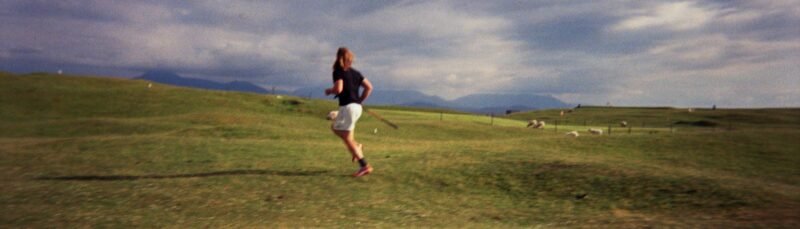
Shot by shot, just getting the arms and club in the air during the backswing became a larger task for me. Every shot meant more, because it seemed to cost more effort to execute. Pre-shot routines, swing planes, ‘shallowing’ thoughts from the last driving range session – all of that stuff I gradually had to throw out the window. Hit the bloody golf ball or die became the inner dialogue. With all that going on, I hardly had eyes for the beauty of the location by the sea and the many sheep that must have roamed the course. I was playing one of my favourite wee links courses in Ireland but we might as well have been anywhere else. Perhaps if consciousness zoned out of some aspects of the game, it would be more present in others?
By the time we ran up 9 towards that last green, me dragging on behind Rob and Maurice, I’d already forgotten most of our score – which I never usually do. Maybe we were 5, 6 over. I do recall us almost birdieing the par 3 8th, where I contributed the tap-in for par. Up on the green – my legs had somehow carried me over the sheep fence – we sank the final putt and shook hands. It clearly was only a walk in the park for Rob, although it did seem enough of an exercise to make him sweat. I, for some reason, didn’t sink to the ground as anticipated. I actually wanted more.
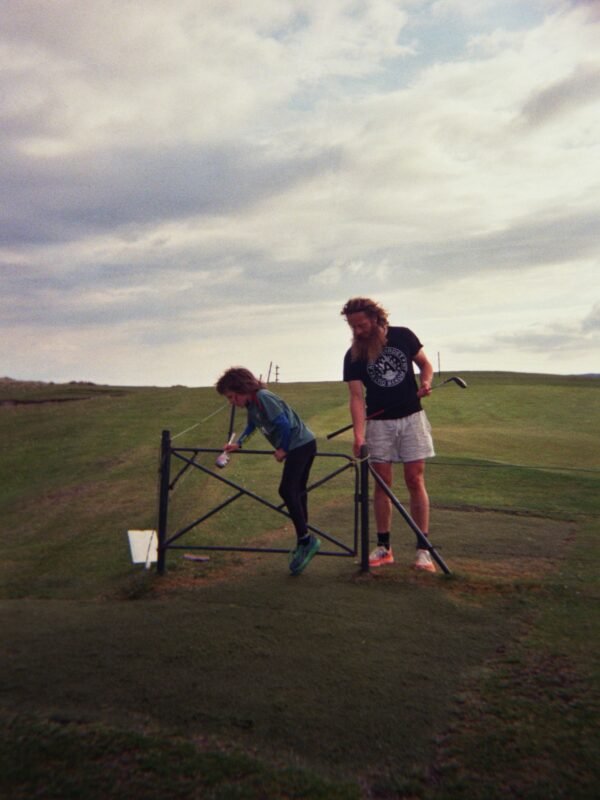
Back at his house within the promised 25 minutes, Rob showed me around the garden, Ruth’s studio, the wood workshop and the garage. He crammed out some of the cardboard scorecards he’d recently used for his TikTok livestreams, including a personal best -5 on 9 holes at Mulranny. “Strange as it sounds, I actually like anonymity, which is why I went on TikTok for the livestreams.” He’d barely had any followers there initially but that didn’t last long. “So, how did you get into this whole social media thing?” I wondered. Rob started explaining how speedgolf got a massive boost when Mike Keiser and Bandon Dunes started supporting the sport round about 2012. In the years following, he had risen to the top of his game and had actually been able to make some decent money off it. “But with Keiser’s endorsements ending in 2017, speedgolf as an organised sport lost its backbone. For me, moving away from competitive play meant that I actually had time to write down all my thoughts on the game and the swing. Not just speedgolf – I also love ‘normal’ golf, it’s just different. And at some point I just started downloading these concepts, and I knew I had to express them.” Although Rob stayed part of the speedgolf scene, the unexpected career change to whatever you want to call it seemed to have paid off. “Luckily, they buy enough of my merch.”
There was one more question I was left wondering about and I really didn’t know how to get it across. Knowing how a lot of golfers are, I kind of thought that surely, someone would take offence to him regularly screaming golf tips into the skies of Mulranny. “Do you… Does anyone mind… When you do your videos…” I mumbled. Rob looked at me, unshaken: “That I’m passionate about golf?”
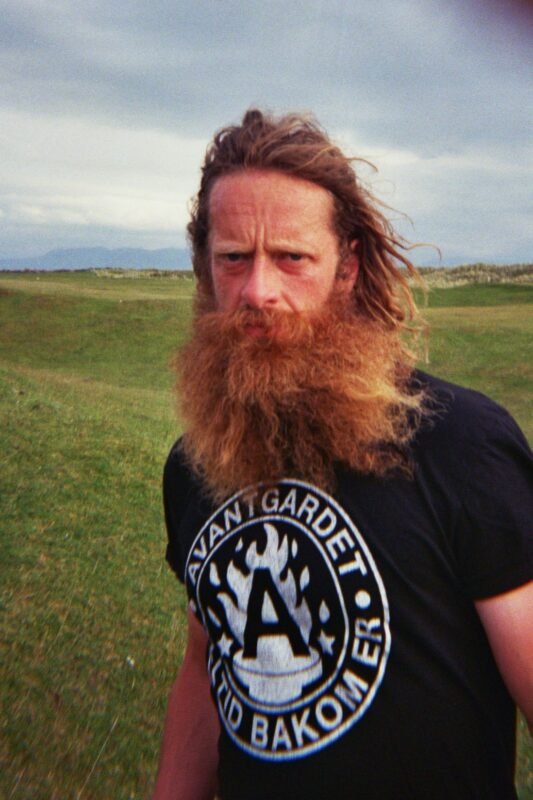
One last push. I’m running up a hill to the 16th tee box of my local golf course, more than a thousand miles from Mulranny. Darkness encroaching, it’s getting harder to see my shots. More than once, I’ve summoned Rob’s spirit running past to keep me going. Since meeting him, I’ve read his speedgolf book and made it a habit to sneak onto the course in the last hour of daylight to try and get 18 holes in. Golf, it turns out, is the only thing that gets me running. After barely breaking 90 during my last round of ‘normal golf’ with 14 clubs, I’m now 6 over playing with 4 clubs, 15 holes and 57 minutes into my round. Can anyone please explain that to me. I gather my breath before starting the backswing, an increasingly heavy 7 iron in hand. I need to really step on it to reach the green 180 yards away. All that’s on my mind is to hit that golf ball. Thinking mode is turned off and play mode on. A split second later, everything magically comes together for a well struck shot, accompanied by an audible groan – not that anyone’s around to hear it. I run downhill towards the green – it almost feels like flying – to find my ball pin high 15 feet from the flag. The following stroke would make any putting coach turn in their grave, but somehow it sends the ball into the hole. Birdie. “Yes, Marúch!” a voice echoes from the trees.
Golf is like practising penalties in football. But speedgolf is trying to hit that shot on goal after a dribble against a defender in the last seconds of overtime. If Rob has taught me one thing, it’s that speedgolf will teach you things about the game that normal golf can not. That knowledge comes from experience. And that when we force ourselves to trust physics, intuition and our bodies, there is a wealth of truth waiting to be tapped into. In some ways, Rob’s the teacher I never had – without ever giving me a swing lesson.